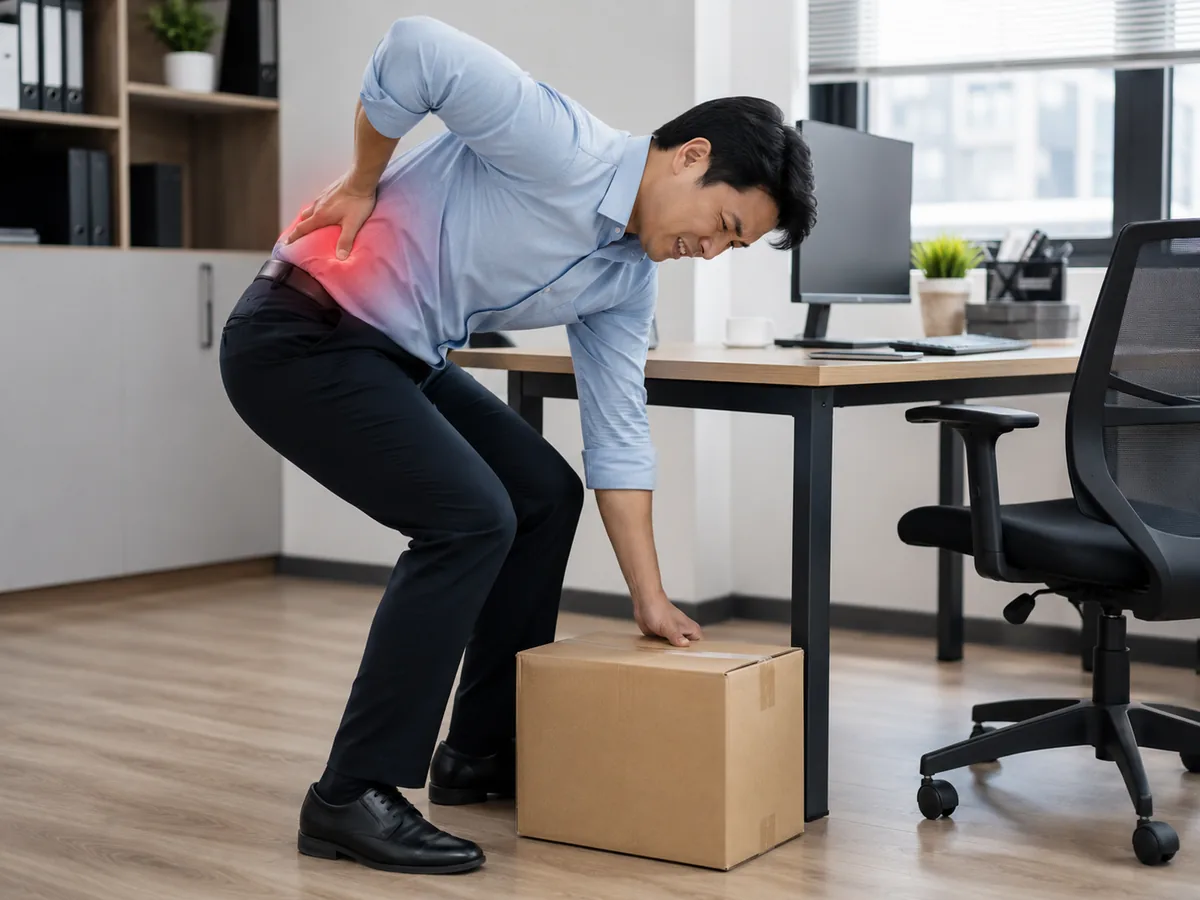
Why lifting heavy or sitting too long triggers lower back pain, how to lift safely, 5 core exercises, ergonomic desk setup, and the red flags to see a doctor — from the YOUNIFY medical team, Bangkok.
Contents
Key Takeaways
- Lower back pain from lifting and sitting is usually muscle strain and awkward posture — something you can often manage and prevent yourself with better posture and a stronger core.
- The key to lifting is "use your legs, not your back": squat instead of bending, don't twist while lifting, set up an ergonomic desk and chair, and move every 30–60 minutes to cut cumulative load on the lower back.
- Most cases improve within two to six weeks, but see a doctor if pain radiates down the leg, the leg goes numb or weak, you lose bladder or bowel control, or there is fever or unexplained weight loss.
Why do lifting and sitting cause lower back pain?
In short, both lifting heavy objects with poor form and sitting for long stretches increase load on the discs and muscles of the lower back. When those muscles work too hard or stay held in one position for too long, they fatigue and become inflamed, which we feel as pain.
Lifting by bending the back and using the back — rather than the legs — to power the movement places excessive load on the lumbar spine. Prolonged sitting, particularly with a slouched posture, raises pressure inside the discs and lets the core muscles weaken. When the muscles that support the spine are not strong enough, the risk of back pain rises. Adjusting posture and building core strength therefore help both relieve and prevent it.
How to lift safely
The key principle is "lift with your legs, not your back." Use the same principle when setting the object down — bend the knees, not the back. Follow these steps every time you lift something heavy:
- Stand as close to the object as possible, with feet about shoulder-width apart for a stable base.
- Bend at the knees into a squat instead of bending your back; keep your back straight and gently brace your abdomen.
- Grip firmly and drive up through your legs and hips, keeping the object close to your body.
- Do not twist while lifting; if you need to change direction, turn your whole body by stepping around.
- If the load is too heavy or bulky, ask for help or use a trolley — do not force it alone.
Five core exercises
Strong core muscles support the spine and reduce the load on your lower back. Perform these slowly, breathe throughout, and stop if you feel pain radiating down the leg. Start with fewer reps and build up — consistency 3–5 days a week works better than one heavy session:
- Pelvic tilt — lie on your back with knees bent; flatten your lower back into the floor by drawing in your abdomen, hold 5 seconds, 10 reps.
- Bird-dog — on hands and knees, extend your right arm and left leg together into a straight line, hold 5 seconds, alternate; 10 reps per side.
- Bridge — lie on your back, knees bent; lift your hips until your body forms a straight line, hold 5 seconds, 10 reps.
- Plank (modified) — on forearms and toes (or knees if needed), brace your abs and keep your body straight, hold 10–20 seconds, 3–5 rounds.
- Knee-to-chest stretch — lie on your back and gently pull one knee toward your chest, hold 15–20 seconds, to release the lower-back muscles.
Set up an ergonomic desk and chair
Arranging your workspace to fit your body reduces the cumulative load on your lower back through the day:
- Chair: sit with your back against the backrest, with lumbar support for the lower-back curve; keep knees level with hips and feet flat on the floor.
- Desk/monitor: the top of the screen should sit at eye level, about an arm's length away, so you are neither looking down nor tilting your neck up.
- Keyboard/mouse: position them so your elbows bend around 90 degrees, with shoulders relaxed rather than raised.
- Move every 30–60 minutes: stand, stretch or take a short walk. Don't hold one position all day.
When it's more than muscle (red flags)
Most muscle-related back pain gradually improves within two to six weeks. But some warning signs (red flags) mean you should see a doctor: pain that clearly radiates down the leg, numbness or weakness in the leg, loss of bladder or bowel control, pain at night that wakes you, unexplained weight loss, fever, or a history of significant trauma or cancer.
If any of these appear, or if your pain does not improve at all despite self-care, get assessed. For guidance when symptoms become persistent, read chronic back pain that radiates down the leg — treatment options. In some cases where leg pain comes from an inflamed nerve root, the medical team may consider non-surgical options such as an epidural steroid injection (ESI) — depending on individual assessment.
In summary
Most lower back pain from lifting and sitting can be managed and prevented yourself — through better posture, a stronger core, and a workspace that fits your body. But if warning signs appear or the pain does not improve, get assessed. See the full overview of our back pain care at back pain care services, or contact us to arrange an initial consultation. Results vary by individual.
Frequently Asked Questions
How many days until back pain from lifting goes away?
Most muscle-related pain gradually eases within a few days to two to six weeks. If it lasts longer, or if pain radiates down the leg, see a doctor for assessment.
Should I use heat or cold for back pain?
In the first day or two of acute pain or swelling, cold packs can help reduce inflammation. After that, gentle warmth helps relax tight muscles. Choose whatever feels comfortable, and avoid heat hot enough to burn the skin.
What should I avoid with back pain?
Avoid lifting heavy objects with poor form, holding one sitting or standing position for too long, sudden twisting, and prolonged bed rest. Gentle, regular movement usually aids recovery more than lying still.
References
- Non-invasive treatments for acute, subacute, and chronic low back pain: A Clinical Practice Guideline (ACP) (Annals of Internal Medicine, 2017)
- Prevention and treatment of low back pain: evidence, challenges, and promising directions (The Lancet, 2018 (Foster NE, et al.))
Medical Note
This article is for general information and does not replace medical examination, diagnosis, or treatment. If symptoms are severe, changing quickly, or urgent, seek medical care promptly.
Want to know which care plan fits you?
Share your symptoms, health history, medications or prior procedures, and personal goals. Our team can help arrange a medical assessment.
Consult YOUNIFY Clinic