Chronic Pain Treatment
Specialist doctor‑led care
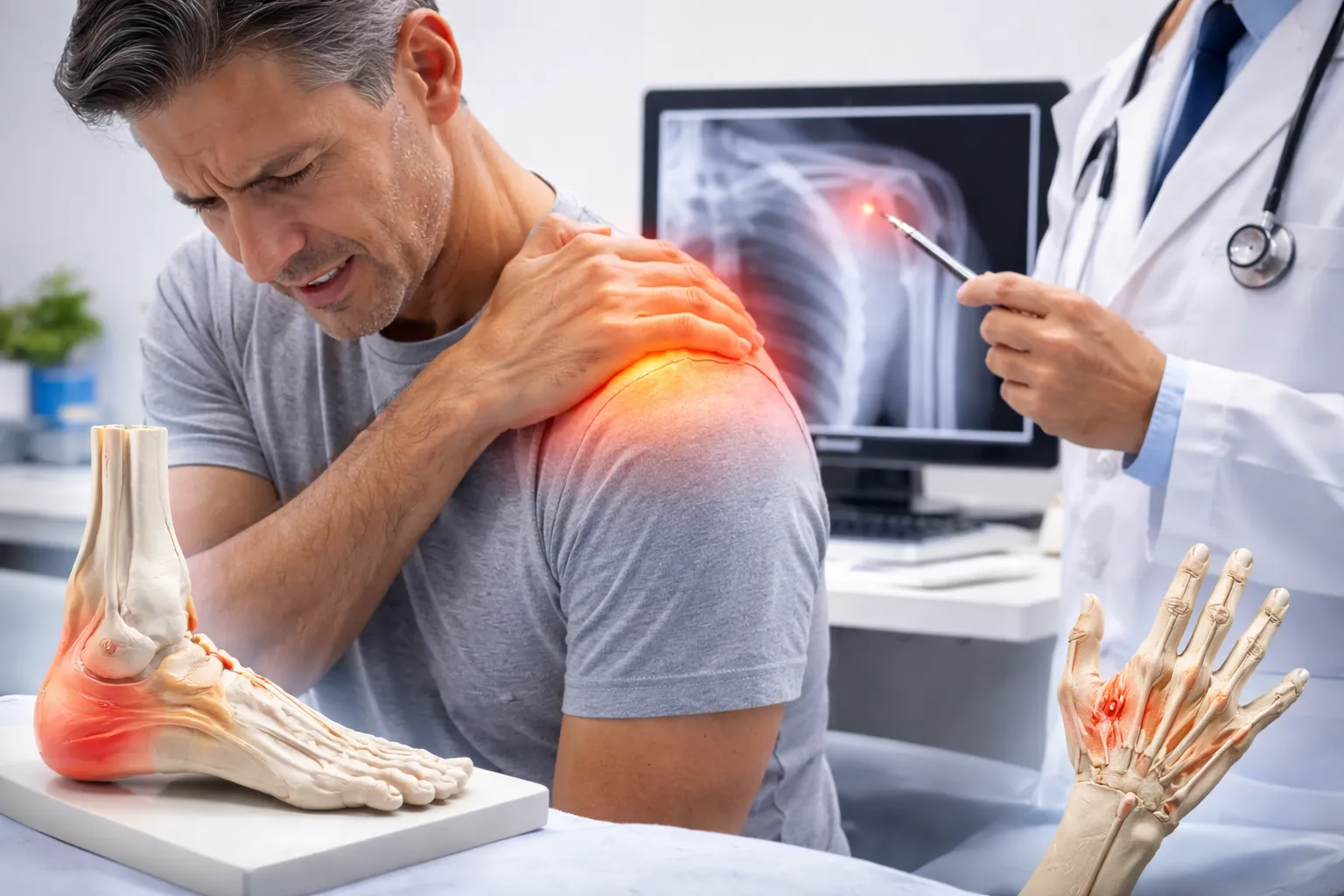
Treat the root cause with TAME — not just temporary relief. For plantar fasciitis, frozen shoulder, and chronic elbow pain.
Specialist doctor‑led care
Treat the root cause with TAME — not just temporary relief. For plantar fasciitis, frozen shoulder, and chronic elbow pain.
Every type of chronic pain has its own source — abnormal blood vessels, facet joints, compressed nerve roots, or muscle. Effective care starts with pinpointing which structure is driving your pain, then choosing the procedure that targets it directly.
Our pain-medicine team performs image-guided procedures under fluoroscopy or ultrasound. Entry points are needle-sized, most procedures need only local anaesthetic, and the majority of patients go home the same day.
In-depth guidance for each symptom pattern
Plantar fasciitis, frozen shoulder, and chronic elbow pain — treated at the abnormal blood vessels that drive the pain.
Facet-joint pain and nerve-root pain radiating to the arm — diagnosed with targeted blocks, treated with RF and image-guided injections.
Facet or SI-joint pain and sciatica-type leg pain — from diagnostic injections to RFA, epidural steroid injection, and balloon neuroplasty.
Every procedure is image-guided and performed by a pain-medicine specialist
Reduces the abnormal blood vessels that drive chronic inflammation and pain.
A small local-anaesthetic test injection that confirms whether the facet joints are the pain source.
Radiofrequency treatment that quiets the pain signal from confirmed facet or SI joints.
Optional joint injection with steroid, PRP, or prolotherapy as an adjunct.
Reduces inflammation around compressed nerve roots; lumbar ESI can use the transforaminal, interlaminar, or caudal route.
Targets a single confirmed nerve root under ultrasound guidance.
An option when epidural steroid injection is unsuitable or relief is insufficient.
Releases epidural adhesions in selected patients with persistent radicular pain.
Releases painful muscle knots when the diagnostic workup points to muscular pain.
Why we start with the least invasive option that fits your diagnosis
| Our image-guided procedures | Open surgery | |
|---|---|---|
| Incision | Needle-sized entry | Surgical incision |
| Anaesthesia | Local anaesthetic ± light sedation | General anaesthesia |
| Hospital stay | Mostly same-day discharge | Several days in hospital |
| Recovery | Back to daily life in 1–3 days | Weeks to months |
| Risk profile | Low | Higher — depends on the operation |
| When it fits | First-line for most patients without red flags | Clear indications such as weakness or spinal cord compression |