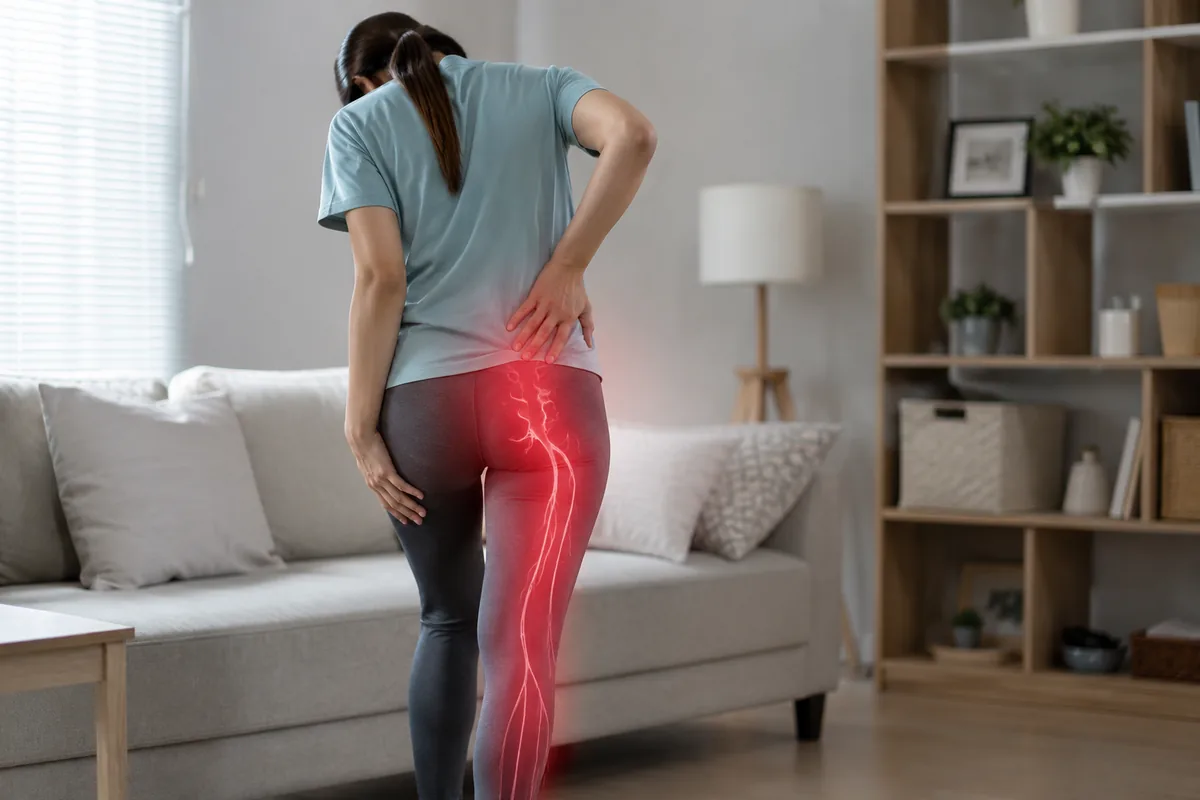
What sciatica (sciatic nerve pain) is, its symptoms, causes from herniated disc and piriformis muscle, and treatment options from conservative care to image-guided injections by our medical team.
Contents
Key Takeaways
- Sciatica is a set of symptoms — not a disease — signalling that the sciatic nerve is compressed or irritated, typically causing pain that radiates from the lower back or buttock down one leg.
- The most common cause is a herniated disc pressing on a nerve root, along with spinal stenosis and a tight piriformis muscle; rapidly progressing weakness or loss of bladder or bowel control needs urgent care.
- Most sciatica improves with conservative, non-surgical care; image-guided injections may help if symptoms persist, and surgery is reserved as a last-line option.
What is sciatica?
Sciatica is not a diagnosis on its own — it is a set of symptoms telling us the sciatic nerve is being disturbed. The hallmark is pain that radiates from the lower back or buttock down one leg, usually on one side only.
The sciatic nerve is the largest nerve in the body. It forms from nerve roots in the lower spine (L4–S3) and runs through the buttock and down the leg. When something presses on or irritates these nerve roots or the nerve itself, the pain signal travels along this pathway, producing discomfort from the buttock through the back of the thigh and calf to the foot. Because sciatica is a symptom rather than a disease, identifying the underlying cause is the key to caring for it well.
What are the symptoms of sciatica?
The defining feature of sciatica is pain that radiates in a line down one leg, often worse with prolonged sitting, coughing, sneezing, or straining. It may come with numbness, tingling, or weakness, and its intensity varies from person to person.
Seek urgent care if you develop rapidly progressing leg weakness, loss of bladder or bowel control, numbness around the buttocks and genitals (saddle area), or severe pain after trauma — these may signal a condition that needs prompt attention.
Common features include:
- Pain radiating from the lower back or buttock into the back of the thigh, calf, or foot, usually on one side
- A burning, shooting, or electric-shock quality that feels different from ordinary muscle ache
- Numbness or a pins-and-needles sensation along the leg
- Pain that worsens with prolonged sitting, bending, coughing, sneezing, or straining
- In some cases, weakness in the leg or foot, or difficulty lifting the foot
What causes sciatica?
The most common cause is a herniated disc pressing on a nerve root. Other causes include age-related spinal narrowing and a tight piriformis muscle compressing the nerve. These factors can also occur together:
- Lumbar herniated disc: when disc material bulges out and presses on a lumbar nerve root — the most frequent cause of sciatica. Learn more in our article on the lumbar herniated disc.
- Spinal stenosis: narrowing of the space around the nerve roots, more common with age.
- Piriformis syndrome: a tight or spasming piriformis muscle in the buttock irritating or compressing the sciatic nerve as it passes nearby.
- Other risk factors: prolonged sitting, lifting heavy loads with poor technique, excess body weight, pregnancy, and age-related degeneration of the spine.
How is sciatica diagnosed?
Diagnosis begins with a history and physical examination by our medical team to assess the pain pattern, muscle strength, sensation, and reflexes. Imaging is then considered only for those who need it.
Typically, the doctor performs a straight-leg-raise test and a neurological examination of the leg to identify which nerve root is involved. If symptoms do not improve as expected, if there is weakness, or if the cause needs closer review, an MRI may be recommended because it shows the discs and nerve roots clearly. X-rays or nerve-conduction studies are sometimes added. Imaging is used to confirm the cause and target the care plan — not everyone needs an MRI from the outset.
What are the treatment options for sciatica?
Most sciatica is cared for with conservative, non-surgical measures first. If symptoms remain disruptive, image-guided injections may be considered to help relieve pain, with surgery reserved as a last-line option only when truly necessary.
1) Conservative care (first line): most people gradually improve with activity modification, avoiding aggravating positions, physical therapy and core-strengthening exercises, and pain or anti-inflammatory medication as prescribed. This is usually the starting point in the first several weeks.
2) Image-guided injections to help relieve pain: if symptoms persist after conservative care, our pain medicine physicians may consider an epidural steroid injection (ESI) or a selective nerve root injection, guided by X-ray or ultrasound. These are needle-only procedures performed without surgery, carried out under the care of our medical team using devices meeting international standards, and most patients go home the same day. Read more in our article on the epidural steroid injection (ESI).
3) Surgery (last-line option): reserved for cases with neurological signs needing prompt attention, progressive weakness, or symptoms not responding to other care. Our medical team always assesses suitability on an individual basis first.
If you also have ongoing back pain, see our overview of chronic back pain.
Gentle stretches that may help relieve sciatica
Gentle stretching may relax the muscles around the hip and reduce tension on the nerve for some people. Move slowly, never force a stretch, and stop immediately if pain increases. If stretching makes the radiating leg pain, numbness, or weakness worse, stop and consult our medical team first. Stretches are early self-care, not a treatment for the underlying cause. Examples of gentle starter stretches include:
- Piriformis stretch (figure-four): lie on your back, cross the ankle of the affected leg over the opposite knee, and gently pull the thigh toward your chest; hold 20–30 seconds.
- Knee-to-chest stretch: lie on your back and slowly draw one knee toward your chest, hold, then switch sides.
- Gentle lower-back mobility: move slowly within a pain-free range.
In summary
Sciatica care at YOUNIFY Clinic is part of our Pain Medicine service, which manages back pain and radiating leg pain with image-guided, needle-based, non-surgical procedures under the care of our medical team. To find out whether your symptoms fit this approach, contact us to arrange an initial assessment. Results vary by individual.
Frequently Asked Questions
Can sciatica get better on its own?
Many people gradually improve over several weeks with self-care and activity changes. However, if symptoms recur, worsen, or come with weakness or numbness, see our medical team for assessment and a targeted care plan. Results vary by individual.
How long does sciatica take to treat?
It depends on the cause and severity. Many people managed conservatively begin to improve within a few weeks, while those who also need image-guided injections follow an individualized plan. Our medical team assesses and monitors progress over time.
Which positions should I avoid with sciatica?
Generally, avoid prolonged sitting, bending to lift heavy loads with your back, forceful twisting, and any position that increases the radiating leg pain. Change positions often and ask our medical team which movements suit your condition.
References
- Non-invasive treatments for acute, subacute, and chronic low back pain: A Clinical Practice Guideline (ACP) (Annals of Internal Medicine, 2017)
- Prevention and treatment of low back pain: evidence, challenges, and promising directions (The Lancet, 2018 (Foster NE, et al.))
Medical Note
This article is for general information and does not replace medical examination, diagnosis, or treatment. If symptoms are severe, changing quickly, or urgent, seek medical care promptly.
Want to know which care plan fits you?
Share your symptoms, health history, medications or prior procedures, and personal goals. Our team can help arrange a medical assessment.
Consult YOUNIFY Clinic