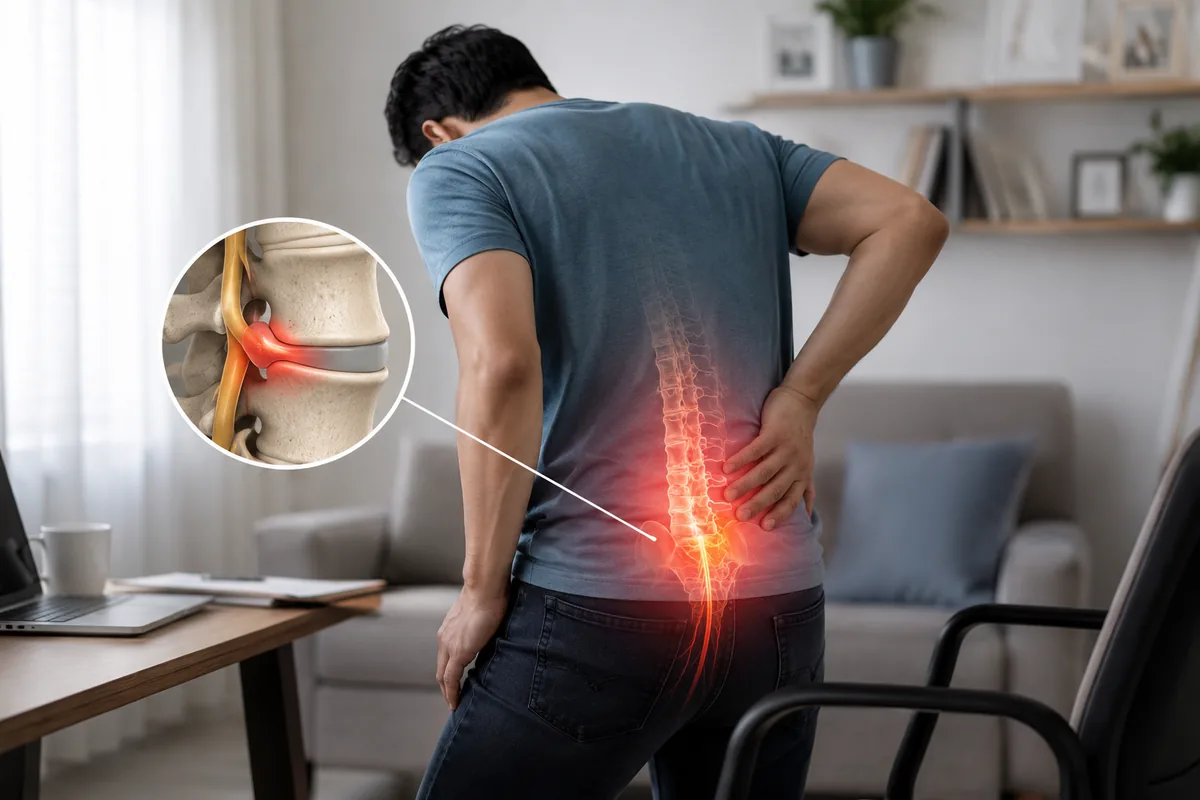
What a lumbar herniated (slipped) disc is, its symptoms, causes and risk factors, MRI diagnosis, and non-surgical versus surgical treatment options, including image-guided injections, by our medical team.
Contents
Key Takeaways
- A lumbar herniated disc is a disc that bulges or ruptures and presses on a nerve root, most often at the lower lumbar levels (L4–L5 and L5–S1), causing lower back pain that radiates into the leg, numbness, or weakness.
- The hallmark is back pain with radiating pain, numbness or tingling into one buttock and leg, often worse with sitting, bending, coughing or sneezing; progressive leg weakness or loss of bladder or bowel control needs urgent care.
- Most people improve with non-surgical care; image-guided injections such as an ESI can relieve radiating leg pain in some, and surgery is kept as a last-line option.
What is a lumbar herniated disc?
A lumbar herniated disc is a condition in which the disc between two vertebrae bulges or ruptures and presses on or irritates a nerve root, causing pain, numbness, or weakness along that nerve. It occurs most often in the lower back.
Each disc sits like a soft cushion between the vertebrae, absorbing load and allowing the spine to move. Inside is a soft gel core surrounded by a tougher outer ring. When the outer ring tears or weakens, the inner gel can bulge toward the side where the nerve roots lie. If it compresses or inflames a nerve root, radiating pain, numbness, or weakness can follow. The most common levels are the lower lumbar discs (L4–L5 and L5–S1), which sit close to the nerves that supply the legs.
What are the symptoms of a lumbar herniated disc?
The hallmark is lower back pain together with radiating pain, numbness, or tingling into the buttock and one leg, often worse with prolonged sitting, bending, coughing, or sneezing. Intensity varies from person to person.
Seek urgent care if you develop progressive leg weakness, loss of bladder or bowel control, or numbness around the buttocks and genitals (saddle area) — these may indicate nerve compression that needs prompt attention. Common symptoms include:
- Lower back pain with radiating pain into the buttock, thigh, calf, or foot, usually on one side (this radiating leg pain is sciatica)
- Numbness, tingling, or a pins-and-needles feeling along the leg
- Weakness in the leg or foot in some cases, such as difficulty lifting the foot
- Pain that worsens with prolonged sitting, bending, coughing, sneezing, or straining, and often eases with a change of position
What causes a lumbar herniated disc, and what are the risk factors?
The main cause is age-related disc degeneration combined with load or injury, such as bending to lift heavy objects with poor technique. Other risk factors include prolonged sitting, excess body weight, and smoking:
- Age-related degeneration: with age, discs lose water and flexibility, and the outer ring becomes more brittle and prone to tearing.
- Load and injury: bending to lift heavy loads with the back, forceful twisting, or trauma can trigger a disc to bulge.
- Habits and risk factors: prolonged sitting, poor posture, excess body weight, a weak core, smoking, and genetics.
How is a lumbar herniated disc diagnosed (the role of MRI)?
Diagnosis begins with a history and neurological examination by our medical team to identify which nerve root is affected. Imaging is then considered only for those who need it, with MRI providing the clearest detail of the discs.
The doctor usually assesses muscle strength, sensation, reflexes, and performs a straight-leg-raise test. If symptoms are clear and respond to initial care, imaging may not be needed right away. However, if symptoms do not improve, if there is weakness, or if a procedure is being planned, an MRI may be recommended because it shows the discs, nerve roots, and soft tissues in detail. X-rays or nerve-conduction studies are sometimes added. Importantly, imaging findings must match the actual symptoms, since some people have age-related disc changes without any symptoms.
Treating a lumbar herniated disc: non-surgical vs surgical
Most people with a lumbar herniated disc improve with non-surgical care. Surgery is reserved as a last-line option, only for cases with neurological signs needing prompt attention or that do not respond to other care.
Non-surgical care (first line): this includes activity and posture modification, avoiding heavy lifting, physical therapy and core-strengthening exercises, and pain or anti-inflammatory medication as prescribed. Many people gradually improve over several weeks to a few months.
Surgery (last-line option): considered when there is worsening weakness, nerve compression needing prompt attention, or radiating leg pain that is highly disruptive and does not respond to non-surgical care and injections. Our medical team always assesses suitability individually and explains the benefits and limitations of each option before any decision.
The role of image-guided injections
Between non-surgical care and surgery, image-guided injections are an option that can help relieve radiating leg pain in many people — without surgery, and usually with same-day discharge.
When radiating pain persists after conservative care, our pain medicine physicians may consider an epidural steroid injection (ESI) or a selective nerve root injection, guided by X-ray or ultrasound for accurate placement. The aim is to reduce inflammation around the nerve root and relieve symptoms, so patients can engage better with physical therapy and daily life. These are needle-only procedures performed without surgery, under the care of our medical team using devices meeting international standards. Read about the steps and preparation in our article on the epidural steroid injection (ESI).
In summary
Care for a lumbar herniated disc is part of YOUNIFY's back pain care service, which manages chronic neck and back pain with image-guided, needle-based, non-surgical procedures — same-day discharge, under the care of our medical team. For the wider picture, see chronic back pain, or contact us to find out whether your symptoms fit this approach. Results vary by individual.
Frequently Asked Questions
Does a herniated disc always need surgery?
Most people do not need surgery, and improve with non-surgical care and, in some cases, image-guided injections. Surgery is reserved for worsening weakness, nerve compression needing prompt attention, or symptoms that do not respond to other care. Results vary by individual.
Can a herniated disc heal on its own?
In many milder cases, symptoms gradually ease over several weeks to a few months with appropriate activity management and physical therapy. If symptoms recur, worsen, or come with weakness, see our medical team for assessment.
Can I lift heavy things with a herniated disc?
During a flare, avoid bending to lift heavy loads. As symptoms improve, gradually return to lifting using good technique — bend the knees, keep the back straight, and hold loads close to the body. Ask our medical team about the activity level that suits your condition.
References
- Non-invasive treatments for acute, subacute, and chronic low back pain: A Clinical Practice Guideline (ACP) (Annals of Internal Medicine, 2017)
- Prevention and treatment of low back pain: evidence, challenges, and promising directions (The Lancet, 2018 (Foster NE, et al.))
Medical Note
This article is for general information and does not replace medical examination, diagnosis, or treatment. If symptoms are severe, changing quickly, or urgent, seek medical care promptly.
Want to know which care plan fits you?
Share your symptoms, health history, medications or prior procedures, and personal goals. Our team can help arrange a medical assessment.
Consult YOUNIFY Clinic