Key Takeaways
- Walking is a beneficial, safe activity for nearly everyone with knee osteoarthritis — it strengthens muscles, eases stiffness, and helps with weight control.
- Running is case-by-case: people with mild osteoarthritis and no pain while running may manage light running, but should avoid it if it causes pain or swelling. Stairs are easier with techniques like using the rail and leading with the stronger leg.
- If walking or stairs cause chronic pain despite full foundational care, GAE (genicular artery embolization) is a non-surgical option that reduces pain in suitable patients — before considering surgery.
Can I walk, and how to do it safely
The answer is yes — you can and should walk. Walking is a low-impact exercise that strengthens the muscles around the knee, eases stiffness, and helps control weight, which is a cornerstone of knee osteoarthritis care. Avoiding walking out of fear actually lets the joint worsen.
The trick is to start with short distances and build up, choosing flat surfaces and well-cushioned shoes. If pain flares, rest and shorten the distance. Mild aching that settles after rest is usually acceptable, but sharp pain or a swollen knee is a sign to adjust.
- Start short and build up; regular walking beats occasional overexertion
- Choose flat surfaces and well-cushioned shoes
- Mild aching that settles is fine; sharp pain or swelling means scale back
Can I run?
Running is case-by-case — there is no single answer for everyone. People with milder osteoarthritis, a reasonable body weight, and no pain during or after running may manage light running on softer surfaces, and there is no clear evidence that gentle recreational running speeds up the disease.
On the other hand, if running causes pain or swelling, or your osteoarthritis is already advanced, avoid running on hard surfaces and switch to low-impact alternatives — brisk walking, cycling, or swimming — which give similar heart and muscle benefits without jarring the joint.
Mild OA, no pain
May manage light running on softer surfaces; go gradually and watch for symptoms.
Pain or swelling after
Best to avoid; switch to brisk walking, cycling, or swimming.
Alternatives to running
Cycling and swimming give similar benefits without impact on the joint.
How to climb stairs with the least pain
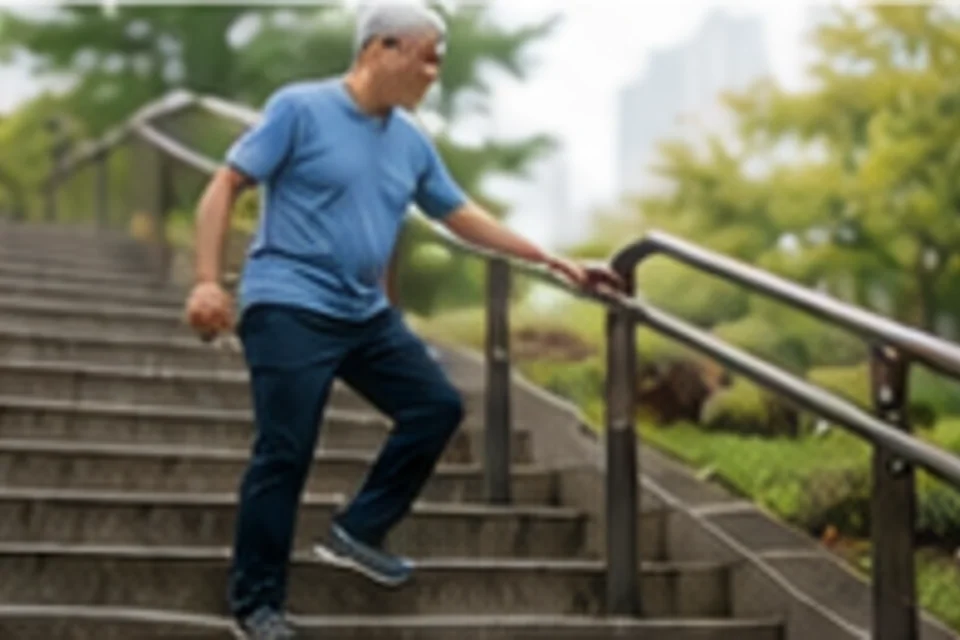
Stairs often hurt because the knee bears several times your body weight, especially going down. The simplest techniques are to always hold the rail for support and balance, and to take one step at a time without rushing.
Leading with the right leg reduces load. Going up, lead with your stronger leg first; going down, lead with the weaker or more painful leg first. A simple way to remember: good leg up, bad leg down. Strengthening the thigh muscles makes stairs easier over the long term.
| Situation | Technique | Why |
|---|---|---|
| Going up | Lead with the stronger leg | The strong leg lifts you, sparing the sore leg |
| Going down | Lead with the weaker/sorer leg | The good leg controls the descent, easing load |
| Up and down | Always hold the rail, one step at a time | Supports weight and balance, reduces falls |
| Long term | Strengthen the thigh muscles | Stronger muscles support the joint |
When to see a doctor, and the GAE option
If walking or stairs become steadily harder, pain persists beyond 1 to 2 months, or the knee is swollen or stiff despite exercise and weight loss, see a doctor for assessment. Foundational care remains something to keep up, but some people need extra help.
For those with chronic pain that affects walking and daily life but who are not ready for — or do not yet need — a knee replacement, GAE (genicular artery embolization) is a needle-sized procedure that reduces inflammation and pain with fast recovery and no open joint surgery. Suitability is assessed individually from imaging and symptoms by the medical team.
- See a doctor if walking/stairs worsen or pain persists beyond 1 to 2 months
- Keep exercise and weight loss as your ongoing foundation
- GAE is a non-surgical option before a replacement, for suitable patients
Frequently Asked Questions
Does a lot of walking make knee osteoarthritis worse?
Walking at a reasonable level does not speed up the disease — it strengthens muscles and helps control weight. What to avoid is overdoing it until pain lingers, or walking heavily on very hard surfaces. If pain flares, shorten the distance and see a doctor if it does not settle.
How many steps a day should I aim for?
There is no fixed number for everyone. The principle is to walk regularly at a level that does not leave lingering pain, then build up as your body tolerates. Starting with a small goal and adding gradually beats sudden overexertion.
My knee hurts a lot on stairs — what should I do?
Always hold the rail, take one step at a time, lead with the stronger leg going up and the sorer leg going down, and strengthen your thigh muscles for the long term. If the pain is severe and constant, see a doctor to assess further treatment.
If running causes me no pain at all, can I keep running?
People with milder osteoarthritis and no pain during or after running can usually keep light running on softer surfaces, going gradually and watching for symptoms. If pain or swelling appears, reduce it or switch to a low-impact activity instead.
References
- OARSI guidelines for the non-surgical management of knee, hip, and polyarticular osteoarthritis (Osteoarthritis and Cartilage, 2019)
- 2019 American College of Rheumatology/Arthritis Foundation Guideline for the Management of Osteoarthritis of the Hand, Hip, and Knee (Arthritis & Rheumatology, 2020)
Want to know which care plan fits you?
Share your symptoms, health history, medications or prior procedures, and personal goals. Our team can help arrange a medical assessment.
Consult YOUNIFY Clinic