Shockwave (ESWT) vs TAME for plantar fasciitis: how each works, sessions, recovery and how the evidence differs — compared by YOUNIFY's medical team in Bangkok.
Contents
Key Takeaways
- Extracorporeal shockwave therapy delivers energy from outside the body, through the skin, to stimulate the tissue's own repair processes — no needle involved, but given as a course of several sessions. TAME is a catheter-based procedure that blocks abnormal blood vessels inside chronically inflamed tissue, done mainly as a single session under local anaesthetic.
- Shockwave has decades of accumulated research but inconsistent results. TAME's evidence is still emerging, limited to small studies, with no large randomised trial to confirm it.
- Neither is a first-line choice: management guidance informed by a systematic review starts with education, load management, stretching, strengthening and footwear. Results vary by individual.
What is the difference between the two?
Shockwave vs TAME plantar fasciitis is a comparison international patients raise with us often — usually after months of stubborn heel pain, physiotherapy done properly, new shoes bought, and a first step in the morning that still hurts. Both are presented as "non-surgical options", but they work through different mechanisms, sit at different levels of invasiveness, and — most importantly — rest on very different bodies of evidence. Here the YOUNIFY Clinic medical team compares them point by point, limitations included. If you are not sure where you sit on the treatment ladder, start with plantar fasciitis treatment in Bangkok: full overview.
The short answer: extracorporeal shockwave therapy delivers energy from outside the body, through the skin, to stimulate the tissue's own repair processes — no needle involved, but given as a course of several sessions. TAME is a catheter-based procedure that blocks abnormal blood vessels inside chronically inflamed tissue, done mainly as a single session under local anaesthetic, usually with same-day discharge.
The deeper difference is what each targets. Shockwave aims at the tissue itself, stimulating repair where the plantar fascia attaches to the heel; TAME aims at the blood supply feeding that area, on the reasoning that abnormal new vessels help sustain the pain. One works from the outside inward, the other from inside the blood vessels outward. The third difference is the one most comparisons skip — how mature the evidence is, which the evidence section below sets out.
How does shockwave therapy (ESWT) work?
Extracorporeal shockwave therapy (ESWT) delivers mechanical wave energy through a handpiece placed on the skin over the heel. The energy travels to the plantar fascia's attachment point to stimulate a tissue response and the body's natural repair processes. There is no puncture, no needle, and no general anaesthetic [2].
The visit is straightforward: our medical team locates the most tender point, applies coupling gel, positions the handpiece and delivers energy in pulses. Intensity is adjusted to what each person tolerates, and you walk out afterwards with no recovery day to plan around.
The point to understand from the outset is that shockwave is not a one-and-done treatment. It is generally given as a course of several sessions spaced a week or more apart, depending on the assessment of our medical team, and change tends to be gradual across and after that course. For patients travelling from abroad that means either an extended stay or continuing sessions at home — worth planning before booking flights. Shockwave sits in the middle of the treatment ladder: used when consistent self-care and physiotherapy have not helped enough, and alongside stretching, strengthening and footwear changes rather than instead of them [2].
How does TAME work?
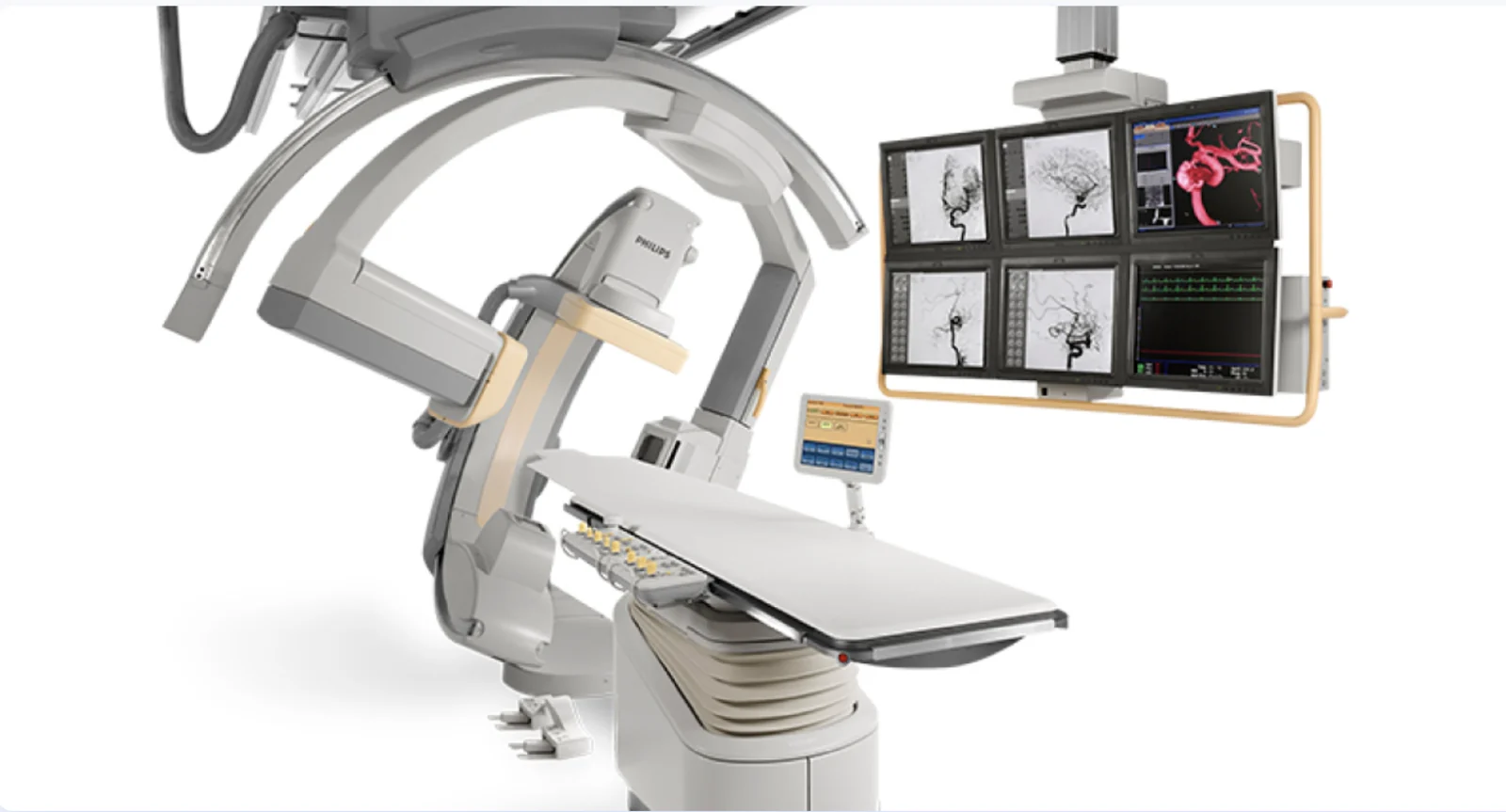
TAME (TransArterial MicroEmbolization) is a procedure in which a doctor advances a very fine catheter through the blood vessels under X-ray guidance and releases tiny particles to block only the abnormal vessels feeding a chronically inflamed area. The goal is to reduce chronic inflammation and ease pain, without an open incision [5].
The rationale comes from an observation about chronically inflamed tissue: abnormal new blood vessels grow into it (neovascularity = new vessels forming where they do not normally belong), and small nerve fibres grow in alongside them. Those fibres are thought to help pain persist long after the original injury settled, so blocking the vessels cuts the supply line to that inflammation-pain cycle. TAME belongs to the same family as GAE (genicular artery embolization) for knee osteoarthritis — the same principle at a different target, here the small arteries around the heel.
TAME is performed under local anaesthetic, and mainly as a single session rather than a course. Afterwards there is a short observation period; most patients recover quickly and usually go home the same day, and pain typically eases gradually over several weeks. It uses instruments meeting international standards, under the care of our medical team. For the full walkthrough, read what TAME is and how it is used in chronic plantar fasciitis.
How does the evidence for each option differ?
Substantially — and this is the section we write most plainly. Shockwave has decades of accumulated research but inconsistent results. TAME's evidence is still emerging, limited to small studies, with no large randomised trial to confirm it.
On the shockwave side: a randomised, placebo-controlled trial by Buchbinder and colleagues, published in JAMA in 2002, studied ultrasound-guided shockwave therapy in plantar fasciitis and found no difference compared with the placebo group [1]. Other studies have reported benefit in particular groups, and current management guidance informed by a systematic review still lists shockwave among the options for people who have not responded to basic care [2]. The honest summary: a long, broad research base, with results not consistent enough to say it works for everyone.
On the TAME side: the procedure-specific evidence is an early-outcomes study in a small group of patients whose plantar fasciitis was refractory to conservative therapy [5]; there is no large randomised trial against a sham procedure. One point deserves stating clearly: the embolic material used in that study was imipenem/cilastatin, which is registered as an antibiotic and is not a licensed embolic agent. Its use in this setting remains investigational and requires further study.
Within the same family: genicular artery embolization (GAE), which applies the same principle to the knee and has more published research behind it, still gives a mixed picture — recent randomised trials against a sham procedure have not agreed with one another. Embolization procedures for pain clearly need more evidence before firm conclusions can be drawn [6].
So our medical team does not decide for you which procedure is superior. We explain what each option suits, what is known and what is not, then decide together on an individual basis. Results vary by individual.
How many sessions, what recovery, and what does it feel like?
In brief: shockwave is a course of several sessions spaced a week or more apart, depending on our medical team's assessment, with no recovery time needed. TAME is mainly a single session under local anaesthetic with a short observation period afterwards; most patients recover quickly and usually go home the same day.
Shockwave feels like a rhythmic tapping over the heel, occasionally sharp over the inflamed point, with intensity adjustable at any moment and some tenderness possible for a few days. During TAME you stay awake but feel no pain at the catheter entry site thanks to the local anaesthetic, sometimes a warm or dull sensation as particles are released. Neither produces an immediate change — expect weeks to months — and either way stretching, strengthening and footwear changes must continue, because a procedure reduces pain but does not change the load your feet carry daily.
Both carry precautions and possible side effects, explained beforehand — particularly TAME, a vascular procedure requiring assessment of your blood vessels, existing conditions and medications. International patients can send their history and previous treatment records before travelling so the first visit is efficient.
Comparison table: shockwave vs TAME
| Topic | Shockwave (ESWT) | TAME |
|---|---|---|
| How it works | Wave energy delivered through the skin to stimulate tissue repair at the fascia attachment | A catheter releases particles that block abnormal new vessels in chronically inflamed tissue |
| How invasive | No needle; applied on the skin surface | Catheter-based, no large incision; more invasive than shockwave |
| Anaesthetic | Generally none; intensity set to tolerance | Local anaesthetic; patient stays awake |
| Sessions typically needed | A course of several sessions a week or more apart, per our medical team's assessment | Mainly a single session, per our medical team's assessment |
| Time to notice change | Gradual across and after the course — weeks to months | Gradual over several weeks, not immediate |
| Level of evidence | Long research base but inconsistent results; some randomised trials found no difference from placebo | Still emerging; small studies only, no large randomised trial |
| Who it suits | Not improving enough after basic care and physiotherapy; able to attend repeat sessions | Treatment-resistant chronic pain after full stepwise care, individually assessed as suitable |
| Limitations / precautions | Repeat visits needed; short-lived tenderness possible; response varies | Vascular procedure with specific precautions; needs vascular and medical assessment; limited evidence |
| Cost | from THB 6,000 per session | from THB 129,000 |
What determines the cost is not the procedure name alone but the number of sessions planned, the assessment and imaging needed beforehand, the complexity of your case, and follow-up. Our medical team sets this out at the initial consultation.
Which option suits whom — and why neither is a first-line choice
The short answer: shockwave is usually considered first, for people who have completed basic care and physiotherapy without improving enough. TAME is considered for genuinely treatment-resistant cases — those who have worked through stepwise care including shockwave and injections where indicated, and still have pain that disrupts daily life.
Shockwave may suit: people with heel pain persisting for months, who have done physiotherapy and footwear changes consistently without enough benefit, who prefer to avoid a needle- or catheter-based procedure, and who can attend a course of repeat sessions.
TAME may suit: people in the chronic, treatment-resistant group who have completed stepwise care, been re-assessed to confirm the diagnosis and rule out anything hiding underneath, and been assessed for vascular suitability and existing conditions by our medical team. For an overview of this group, see chronic plantar fasciitis: where to get treated.
Why neither is a first-line choice: many people improve gradually over several months to about a year with non-invasive care [4], so management guidance informed by a systematic review starts with education, load management, stretching, strengthening and footwear [2]. As for the corticosteroid injection many view as a shortcut, a Cochrane systematic review concluded the benefit is small and confined to a short window [3]. Skipping ahead before the basics have had time to work usually makes it impossible to tell what actually helped — and adds unnecessary risk.
At YOUNIFY Clinic, chronic heel pain is managed within our Chronic Pain service: our medical team takes a history, examines the foot, reviews what you have already tried and considers imaging as needed before discussing the next step. To arrange an initial assessment, contact us through the channels below.
Frequently Asked Questions
Between shockwave and TAME, which one should I choose?
There is no single answer that fits everyone, because the two sit at different rungs of the treatment ladder. Shockwave is usually considered first for people not improving after basic care, while TAME is considered for genuinely treatment-resistant cases and requires individual assessment. Results vary by individual.
I finished a full shockwave course and it did not help — can I go straight to TAME?
It is not an automatic next step. A re-assessment should come first: is the diagnosis correct, is another cause of heel pain hiding underneath, and what has limited the response so far? Our medical team then discusses which option fits your situation.
Is TAME painful? Do I need to stay in hospital?
It is done under local anaesthetic as a catheter-based procedure with no large incision, followed by a short observation period. Most patients recover quickly and usually go home the same day.
Does shockwave require recovery time, and does it hurt?
Generally there is no recovery time — you walk out afterwards. During the session most people feel a rhythmic tapping over the heel, and intensity is adjusted to your tolerance. Some tenderness for a few days afterwards is possible before it settles.
Is there a big difference in cost between the two?
They differ according to the nature of the procedure and the plan agreed with you. Shockwave (ESWT) starts from THB 6,000 per session, TAME from THB 129,000. What determines it is the number of sessions planned, the assessment beforehand, the complexity of your case, and follow-up. Message us on LINE @younifyclinic or WhatsApp for details, starting from an initial consultation.
References
- Ultrasound-guided extracorporeal shock wave therapy for plantar fasciitis: a randomized controlled trial (JAMA. 2002;288(11):1364–1372 (PMID: 12234230))
- Management of plantar heel pain: a best practice guide informed by a systematic review, expert clinical reasoning and patient values (Br J Sports Med. 2021;55(19):1106–1118 (PMID: 33785535))
- Injected corticosteroids for treating plantar heel pain in adults (Cochrane Database Syst Rev. 2017;6:CD009348 (PMID: 28602048))
- Plantar fasciitis (N Engl J Med. 2004;350(21):2159–2166 (PMID: 15152061))
- Early outcomes of transcatheter arterial embolization using imipenem/cilastatin for plantar fasciitis refractory to conservative therapy (Br J Radiol. 2024;97(1155):544–548 (PMID: 38281074))
Medical Note
This article is for general information and does not replace medical examination, diagnosis, or treatment. If symptoms are severe, changing quickly, or urgent, seek medical care promptly.
Individual results may vary. Please consult a doctor before treatment.
Want to know which care plan fits you?
Share your symptoms, health history, medications or prior procedures, and personal goals. Our team can help arrange a medical assessment.
Consult YOUNIFY Clinic