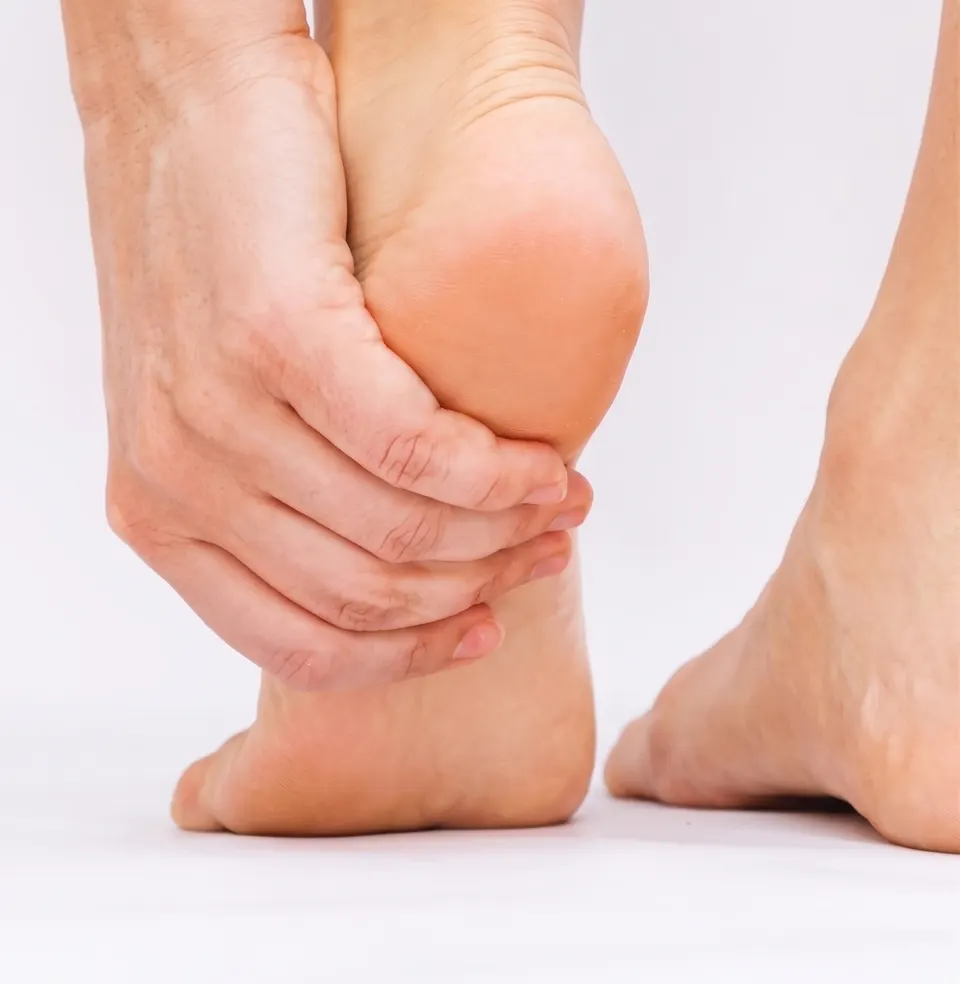
Does plantar fasciitis go away on its own? A doctor-led guide to home stretches, footwear, load management and a realistic recovery timeline — plus when to seek care in Bangkok.
Contents
Key Takeaways
- Many people improve gradually over several months up to around a year with consistent self-care, but some become chronic and should be assessed by a medical team. Results vary by individual.
- What changes the outcome most is not rest by itself. It is consistency — stretching daily, wearing supportive shoes, and controlling how much load your foot takes each day.
- A sensible checkpoint is around six weeks of consistent self-care. If there is no sign of improvement at all by then, see a medical team to review whether the programme fits you.
Does plantar fasciitis go away on its own, and how long does it take?
Does plantar fasciitis go away on its own? It is the first question almost everyone with heel pain asks, and the honest answer is this: many people do gradually improve over several months to around a year with consistent self-care, but a minority stay stuck and become chronic. In this guide, the YOUNIFY Clinic medical team in Bangkok sets out what you can do at home — stretches, footwear, load management, a realistic timeline, and the warning signs that mean it is time to stop self-treating and get assessed. If you would rather see the full menu of options first, start with our plantar fasciitis treatment in Bangkok: full overview.
Plantar fasciitis does tend to settle on its own in many people, usually over several months up to around a year when self-care is consistent. But "settles on its own" is not the same as "do nothing", and it does not happen for everyone — some people are still in pain beyond six months. Results vary by individual.
What changes the outcome most is not rest by itself. It is consistency — stretching daily, wearing supportive shoes, and controlling how much load your foot takes each day. People who do all three steadily tend to notice more change than those who start and stop. Pushing through a full day of walking without changing anything usually keeps the cycle going.
If you are not yet certain that what you have is plantar fasciitis, the classic pattern is a sharp stab in the heel with the first steps out of bed or after sitting, easing as you keep moving. We describe that pattern in detail in heel pain with the first step in the morning.
What are the plantar fasciitis stretches, and how do you do them?
Five movements cover most home programmes: a plantar fascia stretch using toe extension, a straight-knee calf stretch, a bent-knee calf stretch, rolling a chilled bottle under the arch, and slow heel raises for strength. The whole set takes roughly 10–15 minutes and needs no special equipment.
💡 Before you start: the repetitions and timings below are general guidance, not a personalised programme. Work at a stretch that feels like tension, never a sharp stab. If pain increases while you exercise, or is still worse the next morning, stop and ask our medical team or a physiotherapist to adjust the programme for you.
1. Plantar fascia stretch (toe pull)
Sit on a chair or the edge of the bed and cross the painful foot over the opposite thigh. Take hold of the base of all five toes and gently pull them back toward your shin until you feel a line of tension along the sole. Use your other hand to feel the fascia tighten under the arch. Hold about 10 seconds, repeat 10 times, roughly 3 sessions a day.
Many people get the most out of this one before the first step in the morning, while still sitting on the bed, because it can take the edge off that first stab. Repeat it before standing up after any long period of sitting.
2. Calf stretch with the knee straight
Face a wall, hands flat on it at shoulder height. Step the painful leg back, keep that knee straight, press the heel into the floor, and lean slowly toward the wall until you feel tension in the upper calf. Hold about 30 seconds, 3 repetitions, once or twice a day.
A tight calf and Achilles tendon is one of the most common findings in plantar fasciitis, because that tension is transmitted down to where the fascia attaches at the heel with every step. Releasing it reduces the pull at the source.
3. Calf stretch with the knee bent
The same set-up as above, but bend the back knee slightly while keeping the heel down. The tension shifts lower, into the deeper calf just above the ankle. Hold about 30 seconds, 3 repetitions.
Two versions are needed because the calf has two layers that respond to different knee angles — stretching only with a straight knee tends to miss one of them.
4. Rolling a chilled bottle under the arch
Chill a plastic water bottle in the fridge (it does not need to be frozen solid). Sitting on a chair, place the sole on the bottle and roll slowly from heel to the base of the toes and back, pressing only as hard as feels comfortable. Continue for about 2–3 minutes, once or twice a day, especially after long periods on your feet.
A small firm ball works just as well if you have no bottle. This combines gentle massage with cooling. Anyone with reduced sensation in the feet — for example with diabetic neuropathy — should check with our medical team before using cold.
5. Slow heel raises (strength work)
Hold a chair back or counter for balance. Rise onto the balls of your feet over a slow count of three, pause briefly, then lower over another slow count of three. Do 8–12 repetitions per set, about 2–3 sets, every other day so the tissue has time to recover.
As it becomes easy without extra pain, you can add a rolled towel under the toes or progress toward single-leg raises. Stretching helps flexibility, but strength work is what builds the capacity of the tissue to tolerate load, which matters for getting back to walking and training normally. Progress it alongside our medical team or a physiotherapist.
How do you choose footwear and insoles for heel pain?
Shoes that generally suit plantar fasciitis have good shock absorption, a heel that sits slightly higher than the forefoot, a toe box wide enough not to squeeze, and a heel counter that holds firmly without slipping. The goal is to reduce impact and pull at the fascial attachment with every step — not to hunt for one "correct" pair.
Insoles are a reasonable next step and have been studied. A randomised trial found foot orthoses may reduce pain in the short term, although the longer-term benefit was less clear (Landorf KB, et al. Arch Intern Med. 2006). For most people, starting with a prefabricated arch-supporting insole with a cushioned heel is enough to judge the response before considering a custom device with our medical team.
What to avoid while symptoms are flaring
- Walking barefoot on hard floors, especially those first morning steps — keep supportive slides beside the bed instead
- Thin, flat flip-flops or unstructured flat sneakers
- High heels all day, or sudden swings in heel height
- Worn-out shoes with collapsed midsoles or uneven wear
- Switching abruptly to very stiff shoes or minimalist running shoes without a gradual transition
How should you manage load — do you have to stop walking?
You do not need to stop walking altogether. The working principle is relative rest: reduce the volume and intensity of the aggravating activity to a level the foot tolerates, then build back gradually. Complete inactivity lowers the tissue's tolerance, so symptoms often return as soon as you start walking again.
Practically: try cutting your usual walking or running distance by roughly a quarter to a third and watch what happens. A useful benchmark is the 24-hour rule — if pain does not clearly increase afterwards, and the first steps the next morning are no worse, that volume is tolerable. If it is worse, step back to the previous level for about a week, then rebuild in smaller increments.
If you train regularly, swap to lower-impact work during a flare — cycling, swimming, or upper-body strength — to hold your fitness while the foot recovers. When returning to running, add distance in small weekly increments, and avoid increasing distance and pace in the same week. For international patients, this matters on a trip too: long sightseeing days on hard pavement are a load spike, so plan seated breaks and alternate heavy and light days.
Body weight is a relevant factor for some people, since it increases the pressure through the sole with every step. Where excess weight is part of the picture, gradual weight management under the guidance of our medical team tends to reduce the long-term load on the foot, alongside stretching and footwear changes.
What is a realistic recovery timeline?
A common pattern: the first 2–4 weeks rarely bring dramatic change, but you should start to notice small signals — a shorter period of morning pain, or a slightly less painful first step. Weeks 6–12 are where many people feel a clearer difference, and full recovery is usually measured in months. Results vary by individual.
There are two reasons it takes longer than most people expect. First, fascial and tendon tissue has a relatively poor blood supply compared with muscle, so repair is naturally slow. Second, the foot bears weight during almost every waking hour — unlike an injury elsewhere that can genuinely be rested, the tissue is loaded again each day even when you think you are resting.
A sensible checkpoint is around six weeks of consistent self-care. If there is no sign of improvement at all by then, see a medical team to review whether the programme fits you and to confirm the heel pain really is plantar fasciitis rather than something that needs different care. Past six months of consistent care, the problem is classed as chronic, and more targeted options exist — including non-surgical procedures such as TAME for selected patients who have been assessed as suitable. Read more in chronic plantar fasciitis: where to get treated.
When should you stop self-treating and see a doctor?
Stop relying on self-care alone and get assessed when there are signs the pain may not be ordinary plantar fasciitis, or when it is beyond what home care can reasonably manage. These signs do not automatically mean something serious — they mean the picture needs clarifying.
- Numbness, burning, or pain radiating into the sole and toes, which may point to a nerve rather than the fascia
- Sudden pain after an acute injury — a snap or tearing sensation at the heel, followed by difficulty bearing weight
- Swelling, redness, warmth, or fever, which may suggest inflammation or infection needing prompt attention
- Pain at night at rest, or unintentional weight loss alongside the heel pain
- Heel pain in both feet in a younger person, together with other joint pain or morning back stiffness that eases with movement, which can be associated with inflammatory arthritis
- Diabetes, circulation problems, or pre-existing numbness in the feet — have our medical team assess you before starting any home programme
- Pain persisting beyond six months despite consistent stretching, footwear changes, and load management
If you recognise yourself in this list, or you are not sure where to begin, contact us to arrange an initial assessment with our medical team.
Frequently Asked Questions
Does plantar fasciitis go away on its own, and how many months does it take?
Many people improve gradually over several months up to around a year with consistent self-care, but some become chronic and should be assessed by a medical team. Results vary by individual.
How often should I stretch, and can I overdo it?
General guidance is the plantar fascia stretch about three times a day and calf stretches once or twice a day. It should feel like tension, not a sharp stab. If pain increases or lingers into the next day, reduce it and speak to our medical team or a physiotherapist.
Should I use ice or heat?
Cold is commonly used after activity that aggravates symptoms, while warmth may help you feel looser before stretching. Both are for symptom relief — neither replaces stretching and load management.
Do I have to stop running completely?
Usually not permanently. Reduce volume temporarily to a level that does not leave you worse the next morning, then rebuild distance in small increments, without adding distance and pace at the same time.
Prefabricated insoles or custom orthoses?
For most people, a prefabricated arch-supporting insole is enough to judge the response. If there is no improvement, or there is a clear structural issue with the foot, a custom device can be considered with our medical team.
References
- Plantar fasciitis (N Engl J Med. 2004;350(21):2159–2166)
- Management of plantar heel pain: a best practice guide informed by a systematic review, expert clinical reasoning and patient values (Br J Sports Med. 2021;55(19):1106–1118)
- Effectiveness of foot orthoses to treat plantar fasciitis: a randomized trial (Arch Intern Med. 2006;166(12):1305–1310)
- Injected corticosteroids for treating plantar heel pain in adults (Cochrane Database Syst Rev. 2017;6:CD009348)
Medical Note
This article is for general information and does not replace medical examination, diagnosis, or treatment. If symptoms are severe, changing quickly, or urgent, seek medical care promptly.
Individual results may vary. Please consult a doctor before treatment.
Want to know which care plan fits you?
Share your symptoms, health history, medications or prior procedures, and personal goals. Our team can help arrange a medical assessment.
Consult YOUNIFY Clinic